
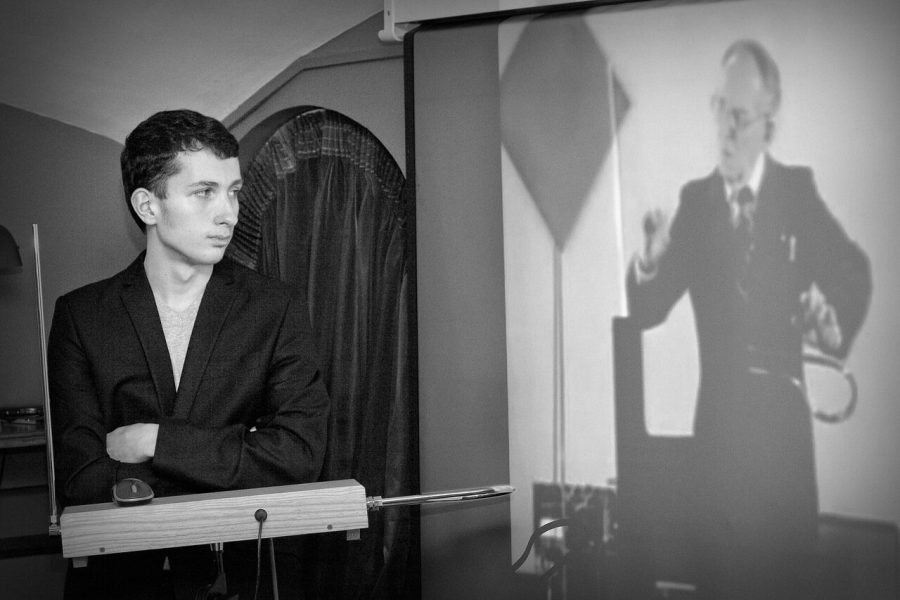
Many electronic musical instruments have remained a part of history, never finding a life on stage—but not the theremin. From the direct descendant of a dynasty of performers on the first electronic musical instrument, we learned why the theremin is so often associated with horror films and how it became an internet meme. Peter Theremin, great-grandson of Lev Termen, spoke about what it is like to be born into the family that invented the theremin, why this instrument became an internet meme and the voice of horror films.
*Author: Maria Blyashon *Moskovsky Komsomolets*
— Do you remember your first personal encounter with the theremin?
— I don’t remember exactly when I first heard the theremin, but it was always present in our family. There are recordings of my grandmother, Natalia Lvovna, playing “Ave Maria” on it, and you can hear me, still a baby, saying something in the background. I think that ultimately prepared me…
— Were lessons on the theremin a natural part of life for you?
— Yes, just as in a family of violinists everyone plays the violin, and there’s nothing surprising about that. When you grow up with something, you understand that here is a room, in it a theremin, a “Red October” grand piano, and you realize it’s as natural as the sun shining, as trees growing—a part of your identity.
— But at some point, did you come to realize that not every family has a theremin?
— I think I always understood that, but rather I simply didn’t give it much thought. I had a shock when I picked up a classical guitar: to me it felt like an exhibit from a museum showcase—strange, interesting, unusual, and I liked that. And of course, I understood that the theremin, too, is an unusual instrument for others, very different, but I probably can’t fully grasp that because it is natural to me.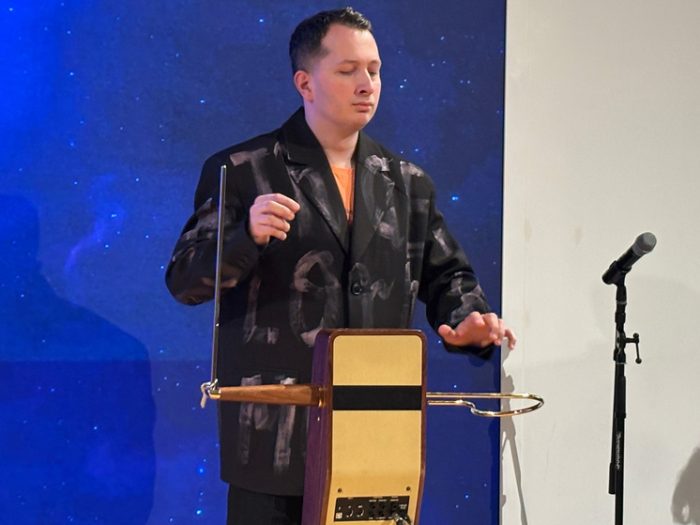
— How did you realize that your life’s work would be connected with this instrument? Perhaps there were other paths—did you ever want to be an ice-cream seller, for instance?
— It’s a strange story. I had been involved with music since childhood; at five or six I wrote my first melody, I played the piano and the guitar, but I started seriously studying the theremin quite late, when I was already about twenty.
— How did that happen?
— Purely for technical reasons! Our family had only one working instrument, and we were afraid it would break or that something else might happen to it. But at some point things started to work out for me: I became fascinated by the instrument’s history, began giving lectures, because I wanted to show and tell about its unique adventures in the cultural history of the past century—and back then few people understood or knew about this. In the process, I keep improving my performing skills, and my grandmother, Natalia Theremin, helps me a great deal—she inspires me as a musician, and she also helps me enormously just as a family member. Yet from a purely musical standpoint, it’s important to have someone whose playing can serve as a benchmark, even though we play very differently, our styles are distinct. Natalia Lvovna plays differently from Lev Theremin , but the approach is the same. And that is the finest embodiment of the connection between performing generations. She has her own playing technique, yet within the key of authentic tradition. And it is very important for me, too, to create something new while remaining within the tradition that lives in our family. I am glad to be able to embody these principles in my work—to play radically experimental music, compositions in other aesthetic frameworks, and at the same time carry a particle of our family tradition.
— What are your favorite pieces for the theremin?
— Many! Most often, the ones I am currently learning. I am constantly adding to my repertoire, and there is a great deal of music I would like to play. The most important thing is the feeling that the music can acquire a new sound on the theremin, not simply taking a well-known melody and playing it—that’s something I’m not very fond of. In a sense, it is important for me to “appropriate” the music, because a performer must interpret a work, be an artist. Take Rachmaninoff’s “Vocalise,” for instance—an utterly beautiful piece, and the theremin can give it new dimensions and new colors. But there are works that don’t suit the instrument very well. I love Russian classical music—Rachmaninoff, Grechaninov, Rimsky-Korsakov—and French music: Gabriel Fauré, Olivier Messiaen, Erik Satie, of course. It is a remarkable coincidence that Lev Termen unites both Russian and French roots, and German ones as well. These are probably the three countries whose music I most often wish to perform: these composers are characterized by melodic thinking, breadth of melody, especially the French Impressionists. A Russian melody is boundless, and it seems a singer’s breath might not be enough for it…
— The theremin is often associated with horror films. Doesn’t that offend you?
— We live in a world of stereotypes, where Tchaikovsky means ballet, Saint-Saëns means “The Dying Swan”—though, by the way, it isn’t dying at all, but very much alive, healthy, and beautiful. All of these are stereotypes that mass culture knows how to impose. The same applies to more complex music. The same applies to avant-garde music: complex and incomprehensible music that often seems cosmic or even frightening. That is why the timbres of electronic musical instruments started being used in cinema with that shade of meaning, although they have other possibilities as well. The theremin can sing like a bird, sound like a violin… The violin, by the way, is often associated with Romani culture—also a stereotype. It’s the same with the theremin: all of this has little to do with the instrument, and in that sense—yes, it is a bit hurtful, I won’t deny it. But it’s part of the instrument’s history, which I even sometimes parody in my performances—a very narrow, small part of its expressiveness. You can also play the violin in a very frightening way, but on the theremin it will sound scarier. The same story applies to the synthesizer and even to the organ, which can sometimes be frightening: not all of its timbres “stroke you the right way.” And I think the more often people discover the theremin from a different side, the less they reproduce this cliché. Lately I hear this stereotype less and less—more often it is associated with outer space. Besides, there aren’t that many horror films in which the theremin is heard, and most of them were made in the 1950s and 1960s; today’s audiences are mostly unfamiliar with them.
— We know what virtuoso pianists or violinists are, but are there virtuoso theremin performers?
— We can speak of virtuosity in two senses. It can be technical, connected to speed of execution, or it can be linked to expressiveness. A performer can play a piece from a music school curriculum, yet do it virtuosically, because it is about a subtle level of mastery of the instrument. There are virtuosos who play the theremin, and here we are talking about a combination of technique and expressiveness. Clara Rockmore, for instance, is considered a virtuoso. Today there are those who have done a lot to popularize the instrument on the internet, very fine performers. But I am generally cautious with the word “virtuoso.” Among performers it isn’t customary to talk like that—that is more something a listener or a critic would say. There are also pieces that represent the peaks of performing mastery, but for the theremin they probably haven’t yet taken shape, because we still don’t know where the ceiling of its possibilities lies.
— The theremin is a star of internet memes with millions of views. Yet the number of performers is small. Why?
— The instrument itself is viral; it arouses the audience’s interest by the very fact of its existence. And there are few performers because learning to play it is harder than it might seem. People often don’t like difficulties; they like things to be simple and quick—one moment, and you wake up famous.
— And indeed, it seems as if playing it is easy!
— Yes, but that’s not quite true. It takes several years of work—not everyone is ready for that. People want to learn in half a year and start editing videos, if the goal is a mass audience. But I think the number of high-quality performers will grow. The theremin is a young instrument; it has everything ahead of it!
